Otherwise known as ‘Gem Scones’, poffertjes are a beautifully simple recipe, but you can really only make them if you have the proper irons…
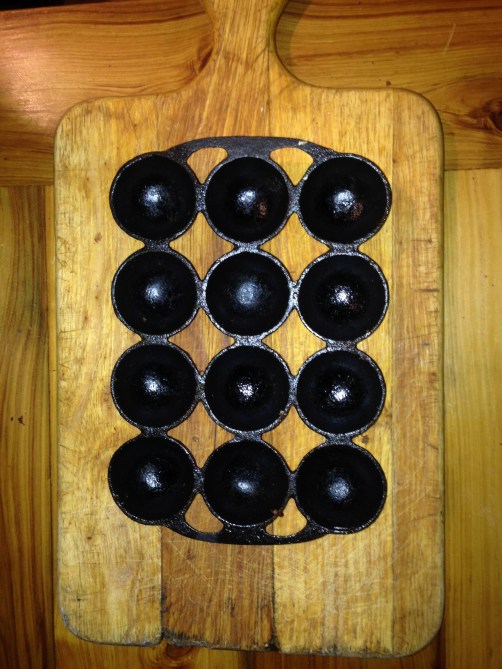
Although I’ve seen that some people use muffin pans, but they end up a bit too flat that way.
I found this recipe way back in 2011 and made a paper (gasp) copy of it, and now I can’t find the website anymore, or even properly credit the person [all my paper copy says along the bottom is “…mac.com/nwjh/…/gem_scones.html”]. So, I am reproducing the words here (with parenthetical and bracket edits of course)…

Gem Scones
(pronounced “Skonz’ with a short “o” in Australia)
Gem Scones appear to be distinctly Australian. [This is patently wrong, as, if you look at the history of this recipe, they derive from a Dutch thing called poffertjes, and were traditionally made with buckwheat flour and yeast, but that is another story…] While they do appear in a few recipe web sites around the world, there seem to be a disproportionately high number of Australian sites or Australian postings on the subject. All the gem scone irons for sale on eBay seem to be from Australia. I’ve never seen them served anywhere but Australia, except at my place! [Enough already! Yes, you may think they are Australian, but actually they are from other places!]
The critical part seems to be the gem scone irons. These are a group of hemispherical cast iron pans, joined together. [Yes, make sure you only get the CAST IRON ones, I had aluminum one for a while and it was AWFUL!] They are designed to hold the heat on the cooking batter. With the bit of butter, the gem scone bakes and fries a bit at the same time. Trying to use thin patty tins [i.e. muffin pans] for gem scones doesn’t appear to work, and there are problems with the scones sticking.
As the scone rises during cooking, the ‘perfect’ shape is approximately spherical, but some odd shapes sometime [sic] occur. Be amused by the shapes, but enjoy them all! The ideal gem scone is soft, light, melt-in-your-mouth and very tasty.
I have my mother’s old gem scone irons (well over 50 years old0, and I picked up a second set at a garage sale in Australia years ago. They work very well and produce gem scones which my boys seem to be able almost to inhale.
You can eat gem scones hot or cold. But I prefer them hot from the oven. Split them, spread a little butter [YES!] or margarine [NO!!] on the cut surface followed by jam [I like lemon butter or maple syrup, myself…]. Scoff with delight. Serve with a good cup of tea [SHEESH! I think you mean COFFEE!!] for a very pleasant repast.
Gem scones are also sometimes (rarely?) known as drop scones, but this [is] not a correct usage of the term. The term ‘drop scones’ is also used for pancakes, pikelets and ordinary scones. [insert some stuff about the cast iron “gem irons”, and the brand ‘Metters‘]; they seem to be about $75 to $95 on the antiques websites, but honestly mine were salvaged half-buried from a paddock and cleaned up by electrolosis with a car battery and some baking soda…yes, really!].
The recipe below is my mother’s, and came with the Metter’s irons.
Ingredients
1 tablespoon butter
1 1/2 tablespoons sugar
pinch of salt
1 egg
1 cup milk
1 1/2 cups self-raising/self-rising flour [I just use regular flour and mix in 1 1/2 tsp of baking powder]
butter to grease the irons, extra.
Method
Pre-heat oven to very hot (525°F/275°C), with the irons in it, so that they are thoroughly hot. Mix butter, sugar and salt. (You can soften the butter, use margarine, and even skip the salt.) Drop in the egg. Cream everything together. Add the milk, then the flour. Mix everything thoroughly. The mixture won’t run, but drops off the spoon. Take the irons out of the oven and place on a safe surface. (Careful! They will be very hot!) Put a small amount of butter (or margarine) in each hemisphere. It should melt quickly and sizzle. You want just enough butter to form a small pool at the bottom when it melts. Swish the melted butter around to coat the sides a bit. Drop mixture into each hemisphere. It will take about 1 Tablespoonful. Leave a little space short of the top of the irons, to allow for expansion. By the time you’ve filled all 12 spaces, the first will be rising significantly! Put irons and mixture into oven, in the middle of a conventional oven. Cook for 5 to 8 minutes, depending upon the oven, etc. The gem scones are ready when they have a light brown tinge on the top. This recipe makes between 18 and 24 gem scones, depending upon how heavy-handed you are putting the batter into the irons. The recipe also scales very well. Doubling or tripling the amount of everything seems to work well for large batches. For serious mass production, e.g., feeding several hungry teenage boys, you should be able to work 3 or 4 sets of irons in series. As each one is emptied and reloaded, the next is ready. Getting the sets of irons is the difficult part.
Further Uses (courtesy of my Mum)
The batter can be used for pancakes.
Use as a top for a sweet pudding for desert, e.g. pour over stewed fruit, then bake until cooked.
Use as a tea cake. Pour the whole mixture into a single cake tin. Then cooked and cooled a bit (but still warm), spread top with a little butter, then sprinkle sugar and cinnamon on top.
Put the batter into paper in patty tins for little patty cakes.
Ta da!!

 Dr Maggie J Watson